

Pilots are People, too.
Mental Health Support and Treatment in Massachusetts for Aviation Personnel, including:
Pilots • Air Traffic Control Specialists • Flight Attendants
Flying is a core part of your identity. I get that.
Whether you’re a pilot or a controller (or both!), flying is part of who you are — and it’s your livelihood. If you're here, you probably fall into one of these camps:
You've been thinking about seeing a therapist for awhile, but you're worried that could ground you, or
Your medical application got deferred and you're looking for a therapist to help get you back in the sky
In either case, you need personalized health care that will get you back to flying and keep you there.
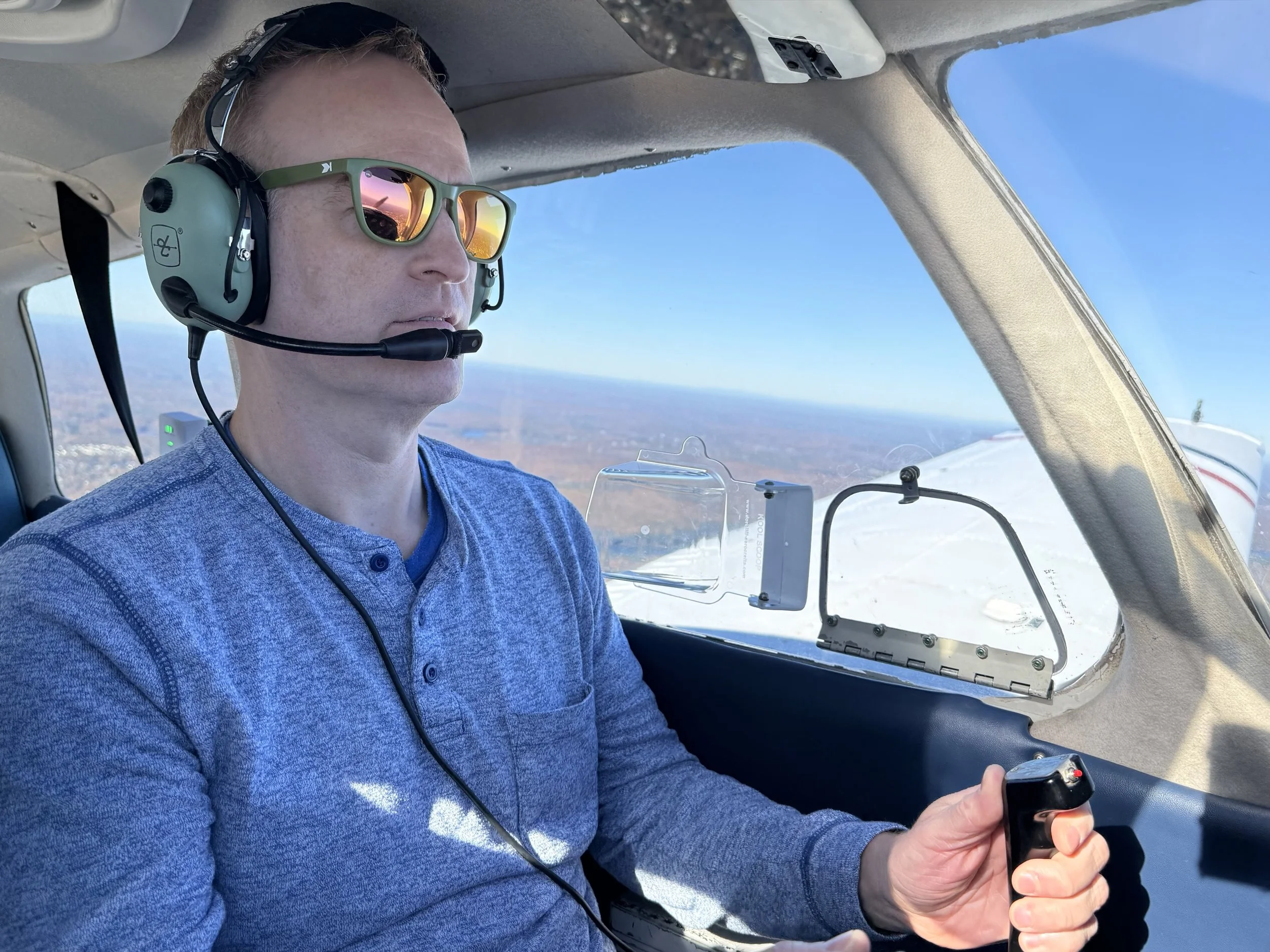
Me on a discovery flight from Minuteman Airport (6B6)
That’s where I come in. I'm an aviation-informed therapist with a passion for human flight. I have over 12 years of experience as a professional counselor, and even more experience from previous roles that drew on the same skill set.
I come to this work with a strong awareness of your context: the constant crossing of time zones, the stretches of time away from family, the uncertainties you face every day. It can be overwhelming, and you need a therapist who understands all that so you don't have to spend a ton of time explaining things.
I'll bring my knowledge, enthusiasm, and experience — which includes my abilities with documentation. Occasionally, the FAA will request documentation from counseling sessions. In those cases, I will know what to document to satisfy those requirements. It’ll be a transparent process, and you’ll be involved every step of the way.
You'll bring a desire for change, and a willingness to be candid about how things are going for you. You can have all the feelings you may already have: apprehension, confusion, worry, frustration. As long as you have the willingness, and ultimately, hope — I got you.
Still have questions?
-
Pilots: Nope. The FAA clearly states that you’re not obliged to report counseling until your next medical.
ATCS: It’s a little murkier here. FAA Order 3930.3C, Chapter 1, section 9.e.1-5 states that, before performing safety-related duties, controllers must notify the Flight Surgeon between medical evaluations about counseling “for, or related to, substance use disorders such as substance dependence, abuse, or misuse (includes alcohol); and/or any mental condition such as anxiety or depression.” That covers a lot of bases.
Also, the way the Order is written is a little backhanded; it says that counseling may be “excluded unless” it’s for any of the above conditions. Which brings us to…
-
Hell no! It is your responsibility, as the aviation professional, to report things like counseling on your medical application. But no — I will never notify anyone, including the FAA or your AME, about your sessions and treatment progress without your knowledge.
In some circumstances, the FAA may request records from your treatment, including counseling. But I won’t share that information with them unless:
I have a signed release from you giving me expressed permission to do so, and
You and I review together what is to be shared with the FAA. I will share with them exactly what they ask for — no less, no more.
-
No. Whether or not you need a diagnosis depends on a couple things:
the severity of your symptoms and impairments in functioning (if any), and
whether or not you want to seek reimbursement from your insurance for out-of-network services.
If you want to use your insurance at all, a diagnosis is necessary. But if you want to get counseling for stressors that might not meet a full diagnosis, you can still get counseling. Insurance just won’t pay for it, and you’ll still have to report it on your 8500. But counseling alone shouldn’t lead to a deferment.
A diagnosis, ultimately, is helpful when the criteria are met. It’s a label that can validate your experiences, help to unburden a lot of suffering and confusion, and open a pathway toward a better life. While that pathway can involve deferment or grounding, it’s actually not that typical. In fact, the FAA Flight Surgeon herself, Dr. Susan Northrup, said that “only about 0.1% of all medical certificate applicants who disclose health issues are final denied.”
A diagnosis can be harmful when criteria aren’t met — no aviation professional should be grounded for a diagnosis they don’t have. We will determine together, in session, whether or not a diagnosis is the right fit for you.
-
Check out this detailed information from the Pilot Mental Health Campaign (PMHC). It takes you through every diagnosis that is acceptable, which require evaluation, and which are disqualifying.
-
While I can’t prescribe medication, I can point you toward new guidance for AMEs that the FAA created around antidepressants! Before starting that type (or any) medication, work closely with the prescriber to understand how it’s supposed to help you.
Things are changing.
The FAA is encouraging aviation personnel to seek mental health treatment — something that, up until recently, was a subject left in the shadows. They’re being very explicit in their encouragement, and have released a lot of guidance over the past couple years:
Therapy, Psychotherapy, and Counseling FAQs for Pilots and ATCS
Information for Psychotherapists Treating Pilots and ATCS (yes, I’ve already read it!)
Also, check this out: it’s a list of the Most Common Medical Conditions reported by applicants for medical certification. Look at the most common conditions (going left to right across the top). They include things like anxiety, ADHD, depression, as well as alcohol and substance abuse. There’s a path back to the flight deck (or to remain on it!) for almost every condition.